
From sketch to score to stage
Browser-based
no installation
Write the music as a graph. Read it as a score.

Spectral
Serial
Counterpoint
Harmony
Jazz
Maqam
Makam
Polska
Tintinnabuli
Stochastic
Microtonal
Live Performance
Grafer is a composer's workbench. You build a pitch field, a rhythm tree, a canon, a maqam or a chorale as a graph of musical decisions, and read the result as engraved notation while you work. Change one decision and the score follows. When the piece is ready it goes to your engraver as MusicXML, or straight to rehearsal on the players' tablets.
One graph, one score
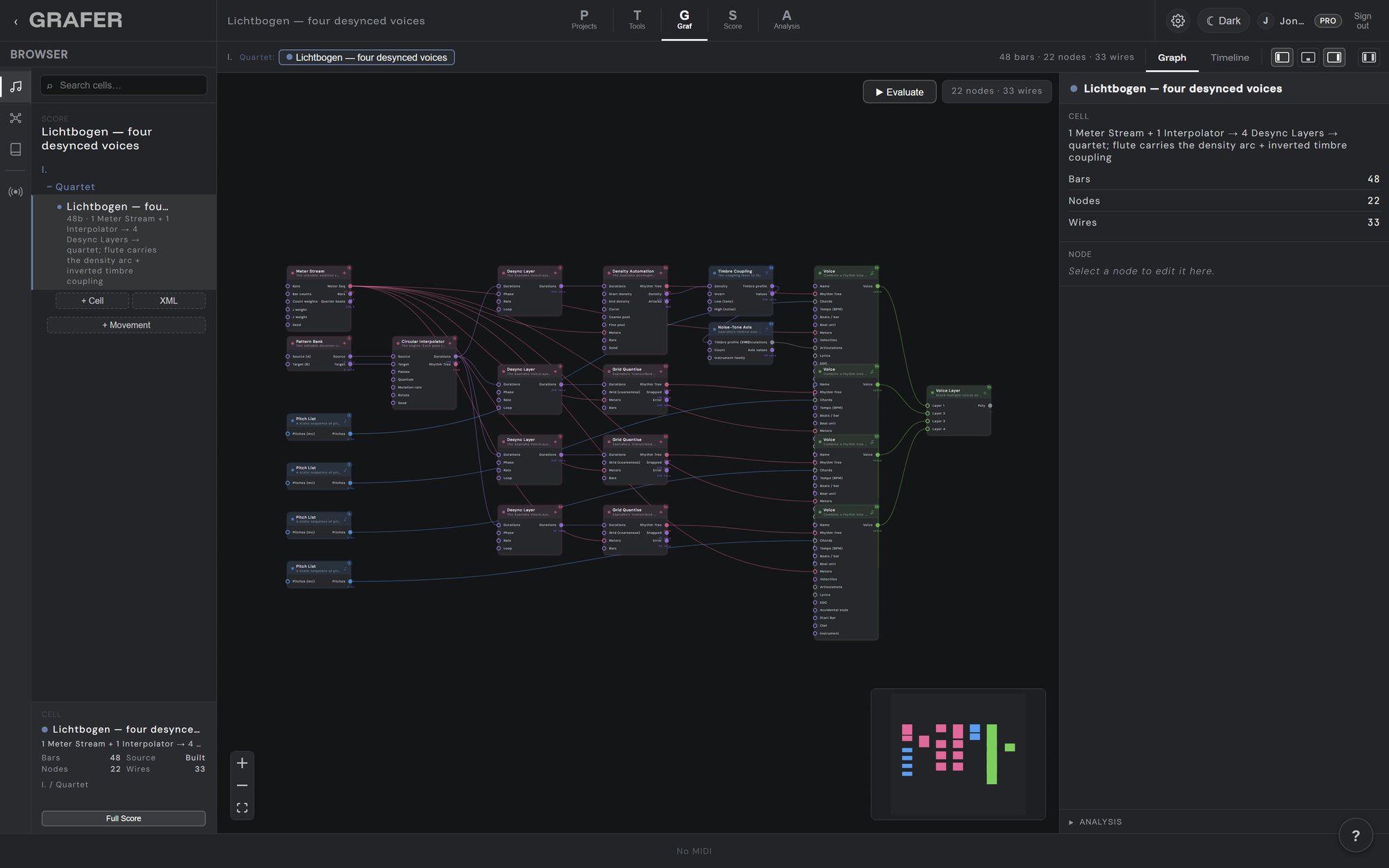
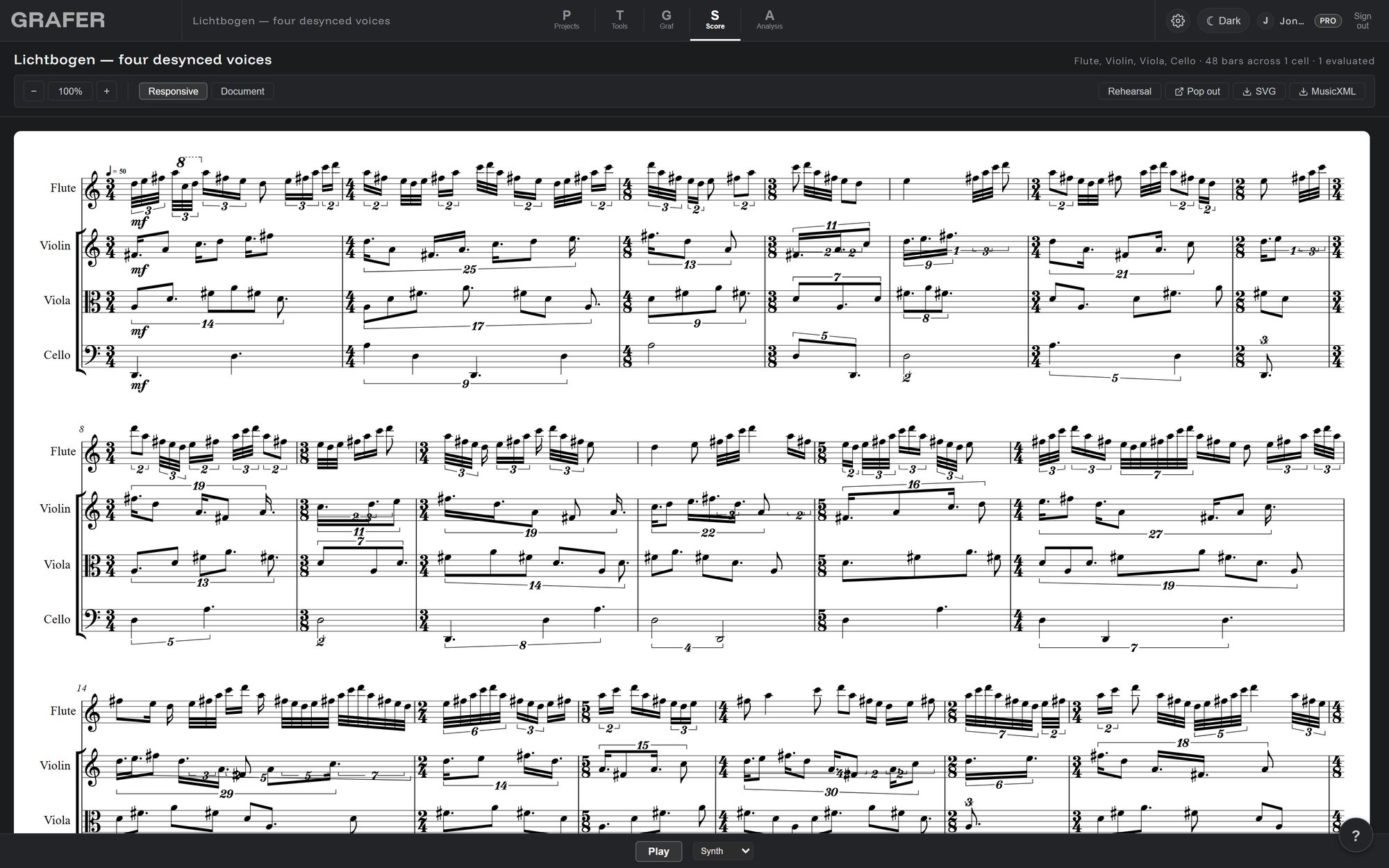
A study in rhythmic interpolation after Kaija Saariaho's Lichtbogen. Twenty-two nodes on the left, forty-eight bars for quartet on the right. Nothing is copied between them: the score is the graph, engraved.
The graph
Graf
One meter stream and one interpolator drive four desynchronised layers. Every wire is a decision you can trace and change.
The score
Score
The same cell for flute, violin, viola and cello. Nested tuplets and changing metres are engraved as you would write them, ready to play back or export.
Think in graphs, hear in notation
Your compositional process as a visible, editable flow of musical transformations. Every connection is a decision you can trace, change, and hear instantly.
Research-grade techniques, zero friction
Pitch multiplication, Markov chains, Brownian walks, FFT analysis, species counterpoint, four-part chorale harmonization and chromatic reharmonization, spectral-microtonal maqam reconciliation — algorithms grounded in compositional theory, accessible without a single line of code.
Compose and perform in one place
The same project that generates your score also drives the rehearsal. Conductor mode, performer tablets, audience view, live OSC to SuperCollider or Max — no export step, no separate tool.
It speaks your technique
Each family of nodes is built on the theory of its own tradition, named the way you would name it at the desk, and free to be wired into any other.
Spectral
Harmonic series, spectral fields, morphing from one to the next, formant filtering. Analyse a recording and compose with its partials.
Serial and post-serial
Tone rows in all their forms, pitch-class sets, interval vectors, Boulez's pitch multiplication, duration series.
Rhythm
Rhythm trees, nested and mixed tuplets, polyrhythm, metric modulation, isorhythm, and Saariaho's interpolation between two patterns.
Counterpoint
Species counter-lines, imitation, invertible counterpoint, stretto and phasing, with a checker that marks the parallels and crossings.
Functional harmony
Harmonise a melody in four parts, realise a figured bass, reharmonise, modulate, choose the cadence. Roman-numeral analysis of what you wrote.
Jazz
Chord symbols, chord-scales, voicings, guide-tone lines, and reharmonisation with tritone substitutions.
Tintinnabuli
Arvo Pärt's two voices: a stepwise melody, and the bell voice that answers it from the triad.
Arabic maqam
Build a maqam or a Moroccan ṭabʿ from its ajnās, weigh each degree against a drone, bend the mode onto an analysed timbre.
Turkish makam
The 53-comma system: twelve makams with their çeşni, seyir melodies that follow the makam's path, and ten usûl.
Swedish folk
Polska with its uneven beats, blå toner, the naturton scale of the willow flute, and a sekundstämma for the second fiddle.
Stochastic and chaos
Random and Brownian walks, Markov chains, Gaussian and Cauchy distributions, logistic and Hénon maps, sieves.
Microtonal
Any equal division, just intonation, your own scale in cents or ratios. Accidentals for 24, 31, 48 and 72 divisions of the octave.
Thirty-eight studies to take apart
Every account opens with an Examples folder. Open a piece, see how it is wired, save a copy and make it yours. The notation below is what Grafer engraved.
Turkish makam
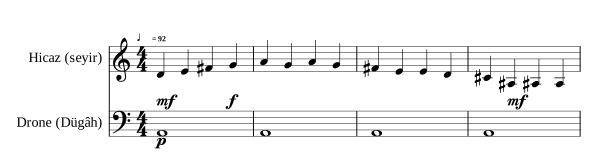
Makam Hicaz — seyir over a drone
The Makam node gives the scale, its güçlü and the direction of its seyir. The Seyir node writes a melody that follows them.
Swedish folk
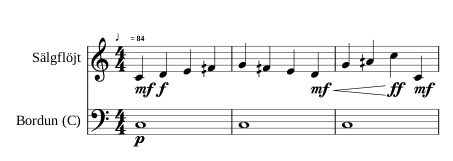
Naturton — sälgflöjt över bordun
A plain tune pulled onto the overtone scale of the willow flute, with its high fourth and low seventh, over a drone on C.

Turkish makam
Aksak — Rast in a 9/8 usûl
The usûl sets the metre, a limping nine counted 2+2+2+3. Makam Rast and its seyir supply the melody.
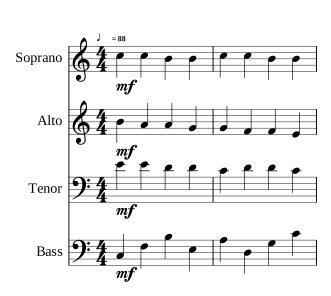
Functional harmony
Circle of Fifths — a harmonic sequence
A descending-fifths sequence in seventh chords. SATB Voicing sets it for four voices and keeps the parallels out.
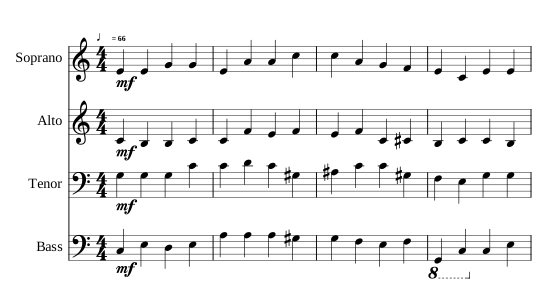
Functional harmony
Brahms' Lullaby, recoloured
The melody stays. Harmonize finds the chords, Reharmonize recolours them chromatically, SATB Voicing sets the four parts.
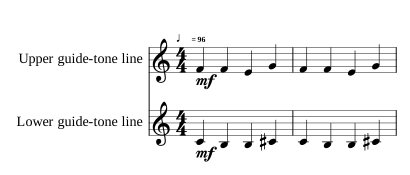
Jazz
Guide-tone lines
Type the changes: Dm7 G7 Cmaj7 A7. Two lines of thirds and sevenths move through them by step.
Also in the folder: studies after Sibelius, Rimsky-Korsakov, Stravinsky, Bartók, Ligeti, Messiaen, Grieg, Ferneyhough and Zappa, each taken apart on its own page. See all thirty-eight studies.
It fits the way you already work
Grafer is where the material is made. The engraving, the tuning files, the recordings and the rehearsal stay in the tools you trust.
Your engraver
MusicXML out, MusicXML in
Send the score to Dorico, Sibelius, MuseScore or Finale with its nested tuplets, microtonal accidentals and transposing instruments in score order. Bring an existing score in, one cell for each part.
Your tunings
Scala files and a library of scales
Import and export .scl files. Start from 45 scales of eight traditions, from maqam and dastgah to raga, slendro and pelog, or enter your own in cents or ratios.
Your sounds
Compose from a recording
Load a recording and read its spectrum as a single chord or as partials that move in time. Turn what you find into a pitch field or a tuning. SDIF goes in and out.
Your ensemble
Rehearsal without printing parts
Players join with a code, choose their part and read it on a tablet. Conductor mode walks the piece cell by cell, and the audience can steer it from their phones.
Who makes it
Written by a composer
Grafer is made by Jonas Pettersson, a Swedish composer and developer. A question about a technique, a node that is missing or a bar that came out wrong goes straight to him, at hello@grafer.app.
What it costs
or €9 a month. Composer Pro: unlimited projects, unlimited performer seats, the assistant every day. The first fourteen days are free and need no card. After that the free plan keeps every node, playback and export, with three saved projects.
Volume licensing for universities and conservatories: get in touch.
Start composing.
It's free for 14 days.