
Examples
46 studies to take apart
Every grafer account opens with an Examples folder: 46 studies, each a small piece built from nodes after a technique or a composer. Open one, see how it is wired, save a copy and make it yours. The notation on these pages is what grafer engraved from the graphs.
Functional harmony
Cadences, sequences, reharmonisation and analysis, voiced in four parts.

Functional harmony
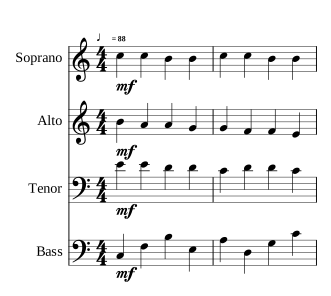
Cadence Gallery — the seven closes
The seven cadence types, one per cell — each spelled and voiced in four parts.
Functional harmony
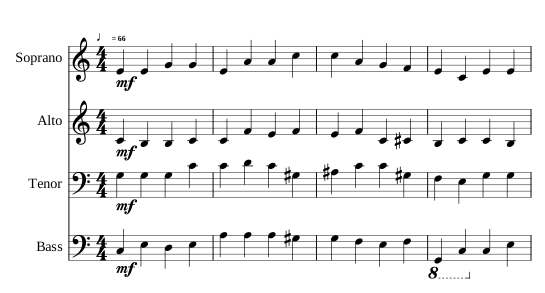
Circle of Fifths — a harmonic sequence
The descending circle-of-fifths sequence, voiced in four parts.
Functional harmony
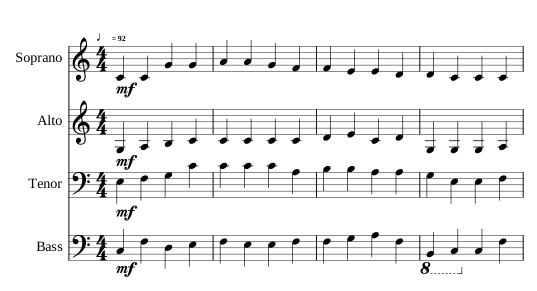
Romantic Reharmonization — Brahms' Lullaby recoloured
Brahms' Lullaby recoloured with the chromatic-harmony toolkit.
Functional harmony
Analyze a Progression — Roman numerals & key
Roman-numeral analysis with automatic key detection.
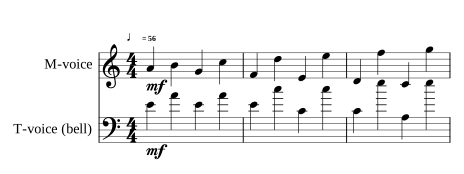
Tintinnabuli
Arvo Pärt's two voices: a stepwise melody and the bell voice that answers it.
Jazz
Chord symbols, guide-tone lines and tritone substitutions.
Jazz
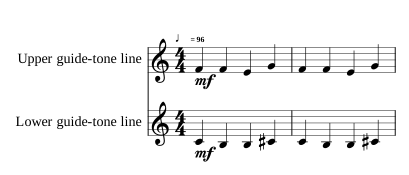
Jazz — Guide-Tone Lines
Guide-tone lines (3rds & 7ths) threaded through a ii–V–I turnaround.
Jazz
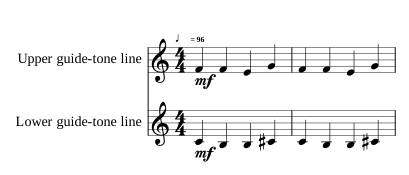
Jazz — Reharmonization
A turnaround recoloured with tritone subs, voiced as guide-tone lines.
Turkish makam
The 53-comma system, seyir melodies and usûl cycles.
Turkish makam
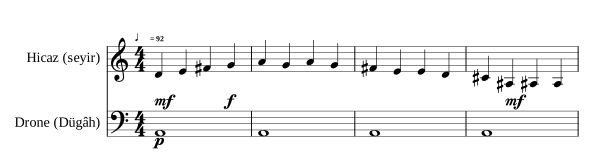
Makam Hicaz — seyir over a drone
A Turkish makam study: Hicaz on the AEU 53-comma grid, its seyir spun over a tonic drone.

Turkish makam
Aksak — Rast in a 9/8 usûl
The limping Aksak 9/8 usûl driving a Rast melody — Turkish rhythmic cycles in action.
Swedish folk
Polska, blå toner, the willow flute's overtone scale and the second fiddle.
Swedish folk
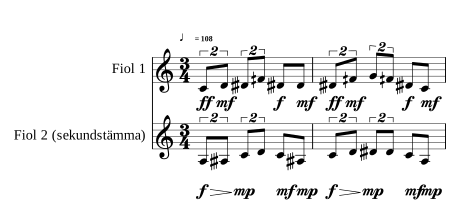
Bodapolska med sekundstämma
A Dalarna polska with folk intonation (blå toner) and a second-fiddle sekundstämma.
Swedish folk
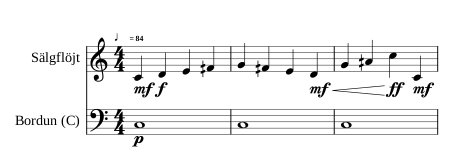
Naturton — sälgflöjt över bordun
The willow-flute overtone scale (naturton) — a melody on the natural harmonics over a drone.
Sibelius
Process, pedal points and thematic germination in the symphonies.
Sibelius
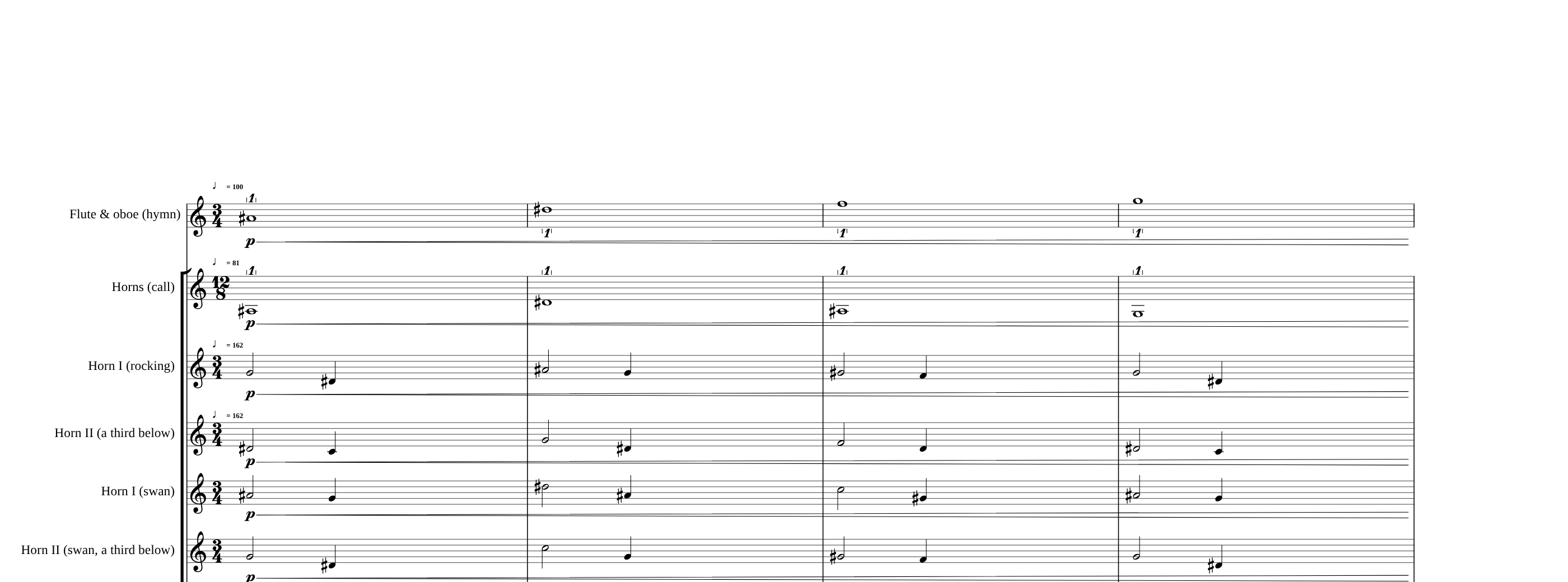
Sibelius V — the swan hymn and its seams
Sibelius's Fifth as process: a scherzo tempo derived by metric modulation, the rocking-horn swan hymn under one long crescendo, six hammer blows in…
Sibelius
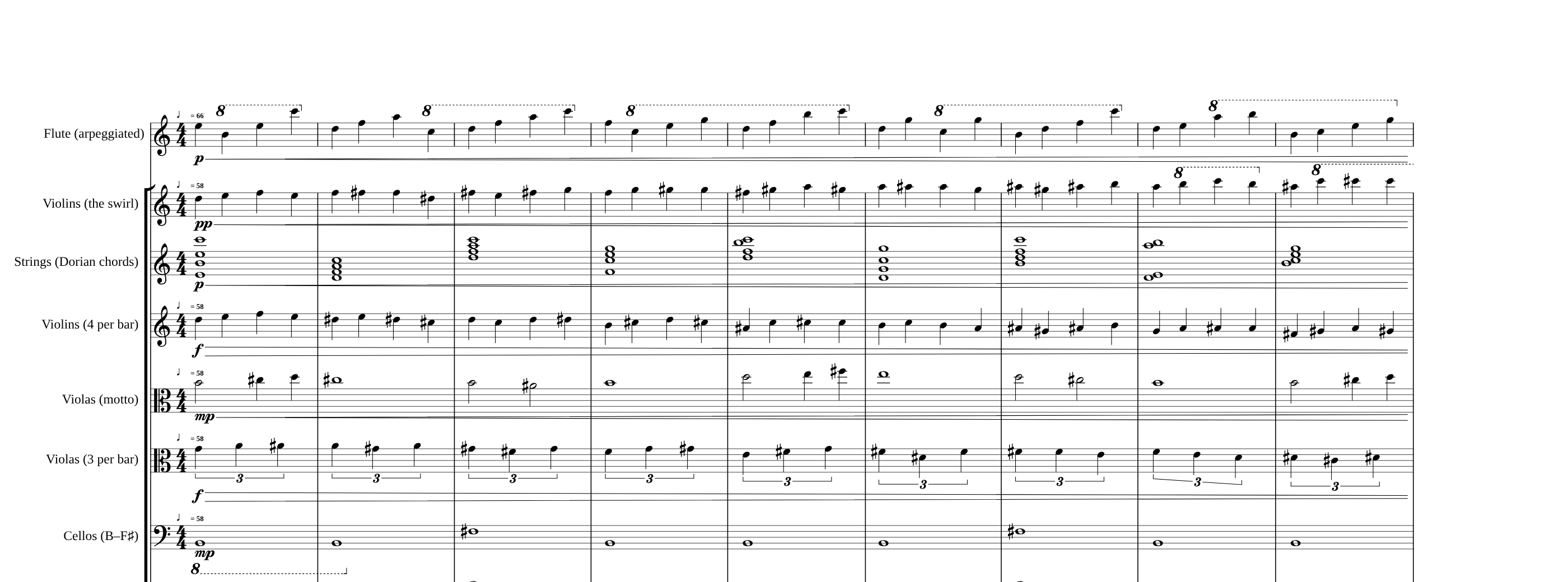
Tapiola — a pedal point and the forest above it
Sibelius's pedal point: a bass that never moves while the forest swirls above it, the Sixth's Dorian colour, a storm subsiding in three speeds.
Sibelius
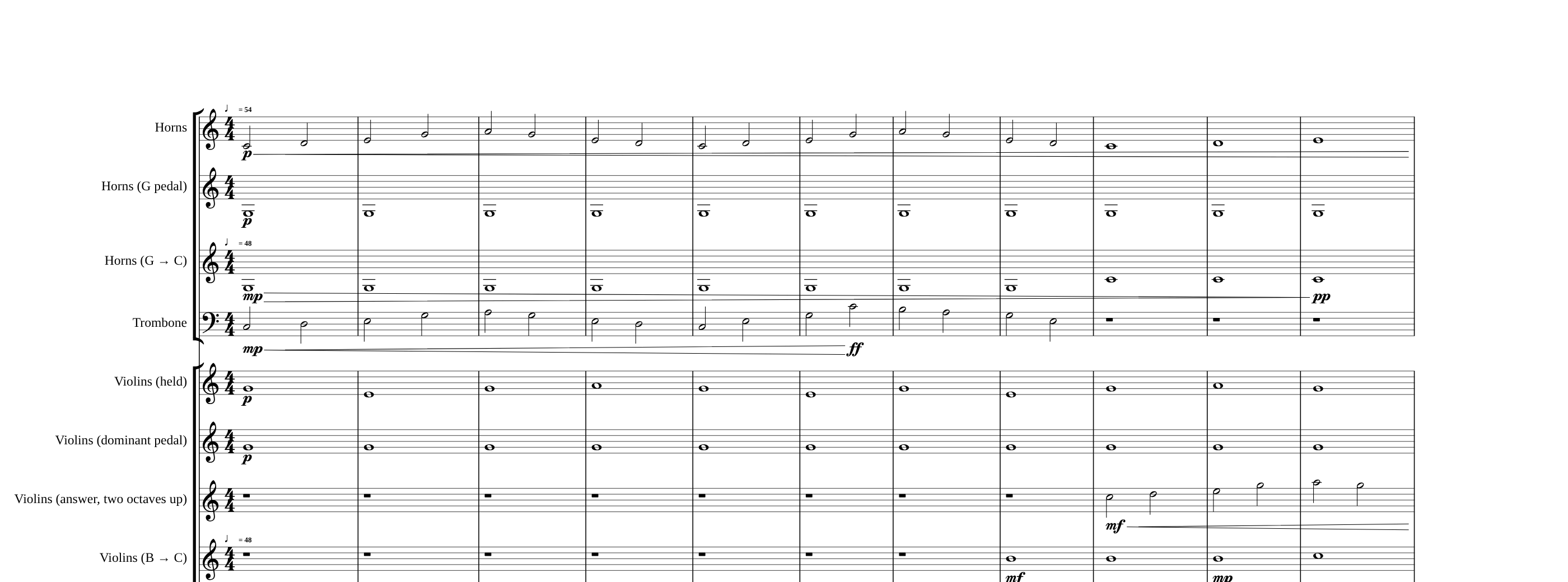
Sibelius VII — a theme that grows from its fragments
Sibelius's thematic germination: one theme revealed three notes, eight, then all sixteen at a time — and dissolved again in the coda.
Rimsky-Korsakov
Octatonic magic, changing backgrounds and a chromatic engine.
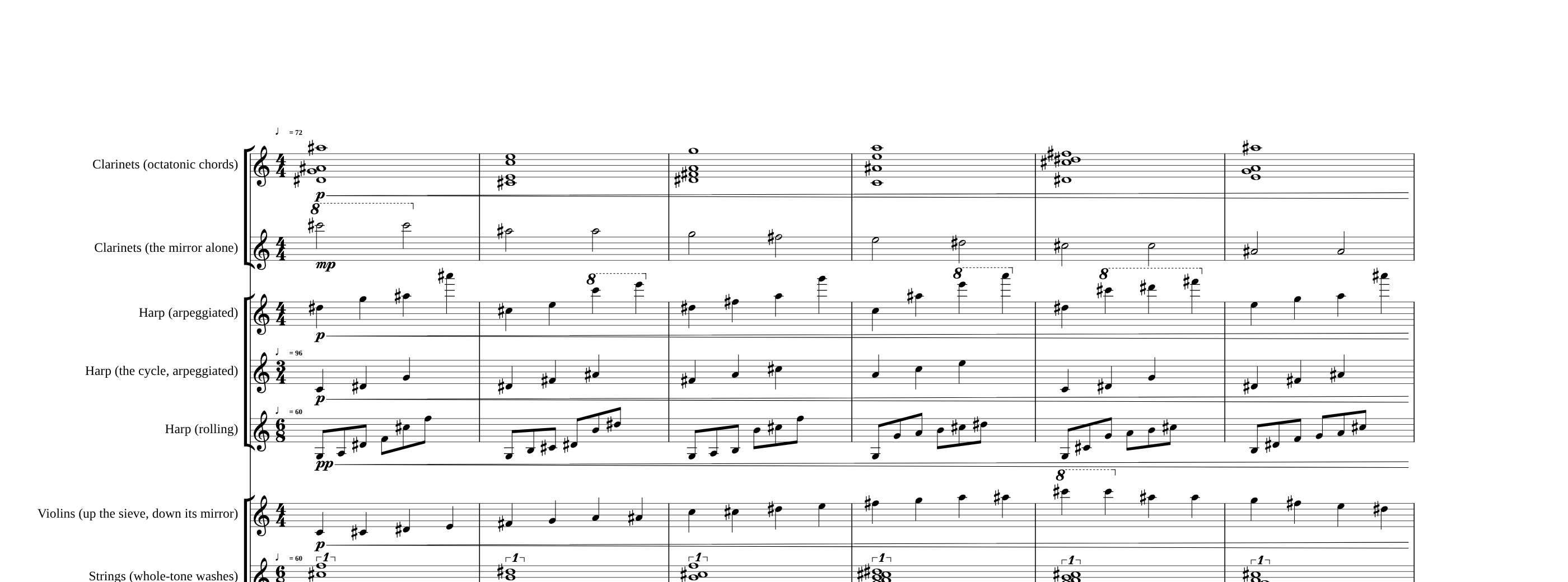
Rimsky-Korsakov
The Golden Cockerel — octatonic and whole-tone magic
Rimsky-Korsakov's magic scales: the octatonic as a pool, a sieve mirrored onto itself, and a cycle of triads a minor third apart — then the…
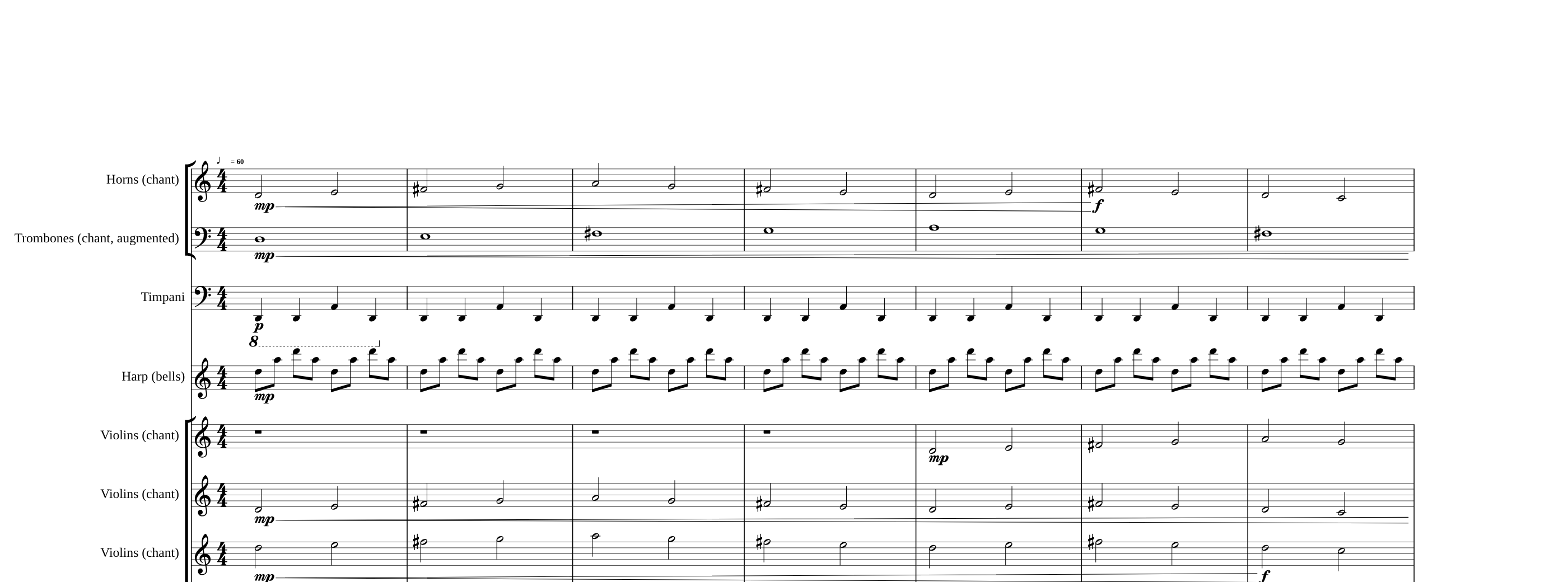
Rimsky-Korsakov
Russian Easter — one chant, five backgrounds
Changing-background variations: one obikhod chant, unchanged, under a drone, two chorales, a pandiatonic wash with bells and an ostinato.
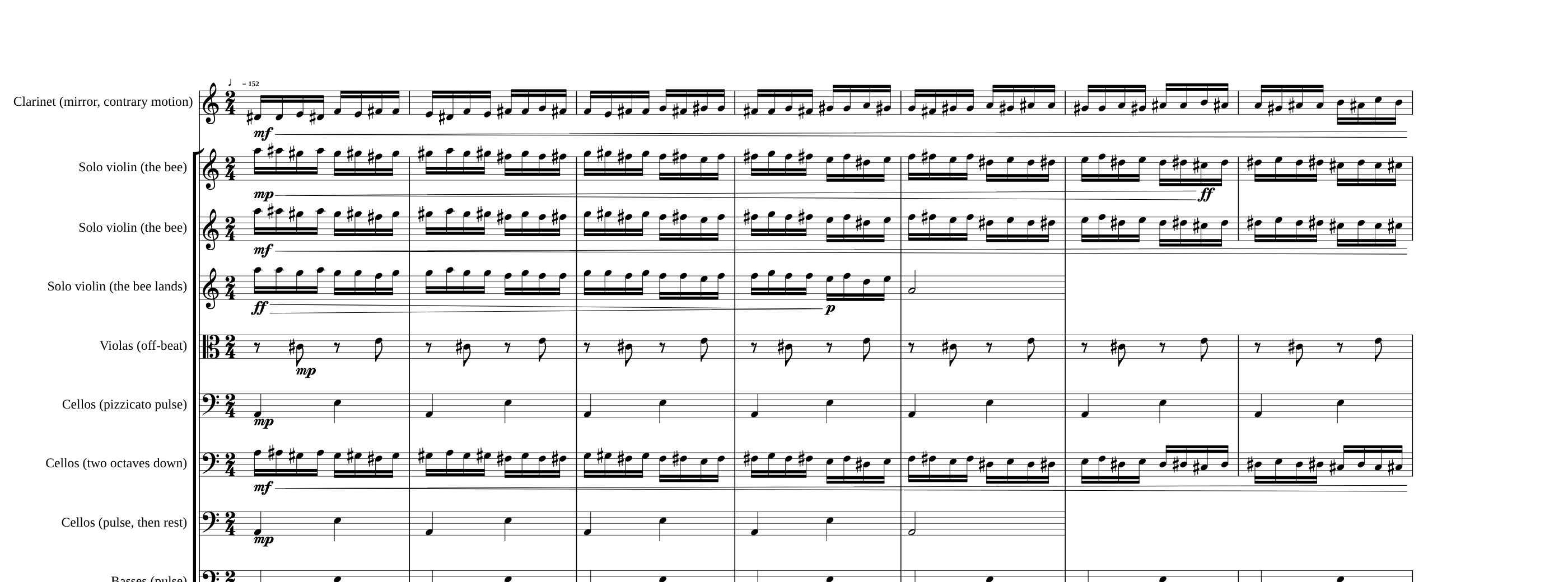
Rimsky-Korsakov
Flight of the Bumblebee — a chromatic engine
Flight of the Bumblebee as a machine: a falling chromatic wave interleaved with its upper neighbour, mirrored, doubled, and quantised to land.
Stravinsky
Polychords, additive meters and a rotational array.
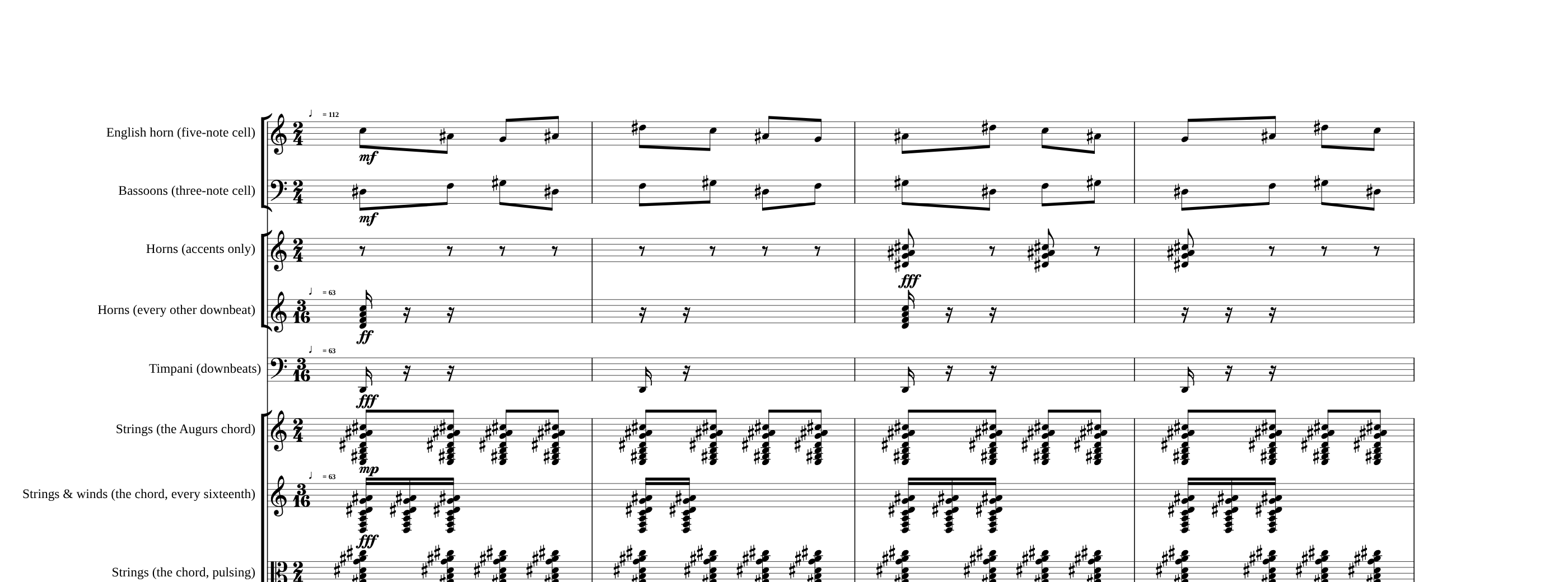
Stravinsky
The Rite of Spring — a chord, a cell, and additive meters
The Rite of Spring: the Augurs polychord with its irregular accents, a folk cell whose barline drifts, and the Sacrificial Dance's additive meters.
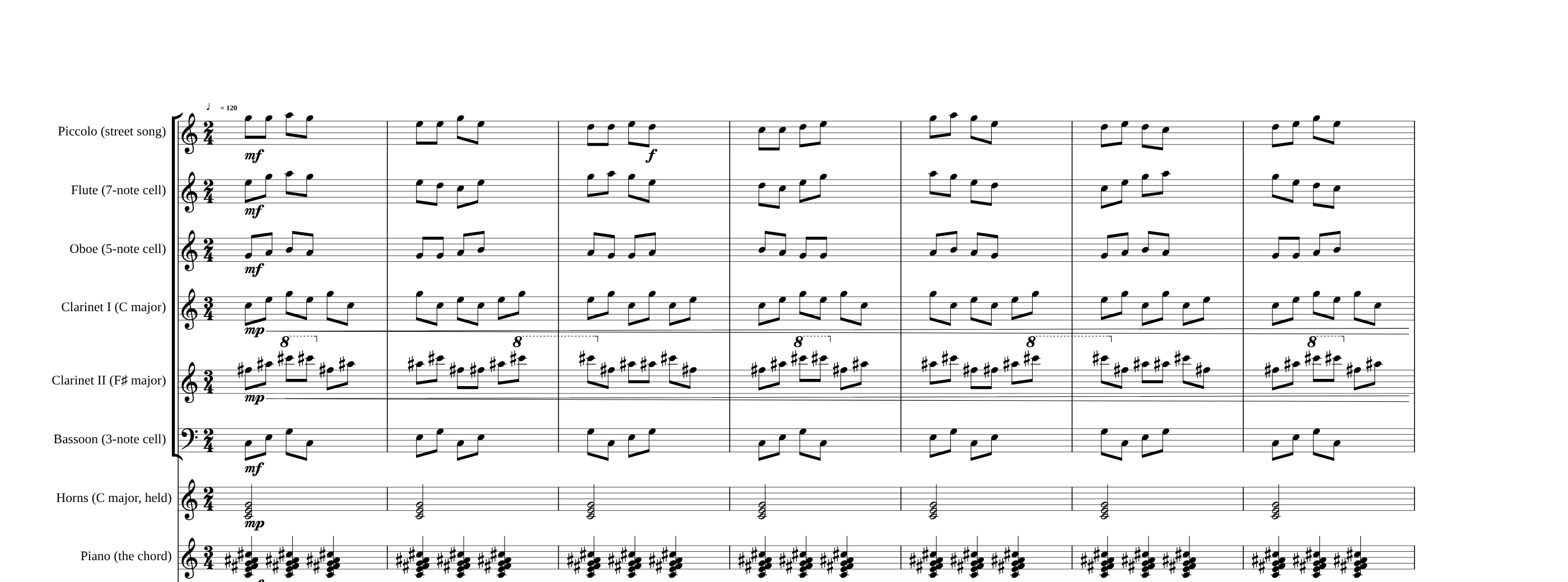
Stravinsky
Petrushka — two keys at once, ostinati out of phase
Petrushka: the C/F♯ polychord split into two clarinets from one node, ostinati of 7, 5 and 3 notes out of phase, and the fair's pandiatonic harmony.
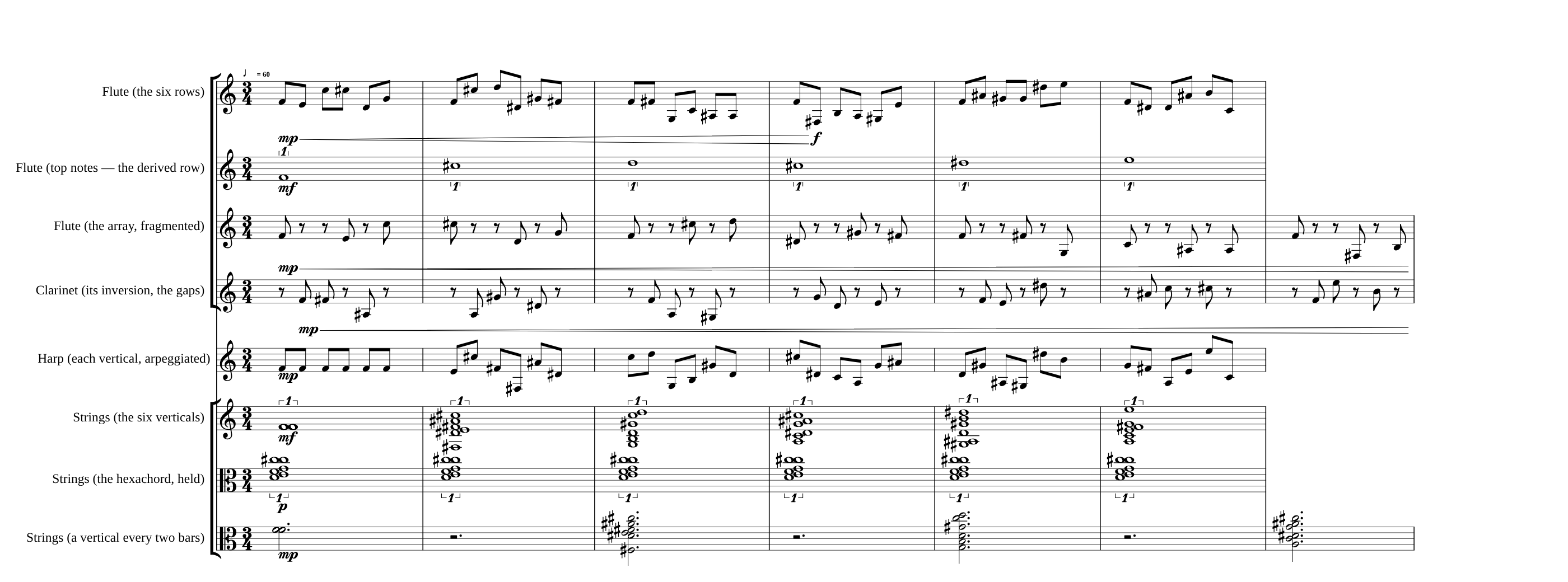
Stravinsky
Requiem Canticles — a rotational array
Requiem Canticles: a hexachord rotated and transposed into six rows, read across for melody and down for the verticals, then fragmented through rests.
Zappa
Statistical density, Lydian vamps in 19/16 and Synclavier stochastics.
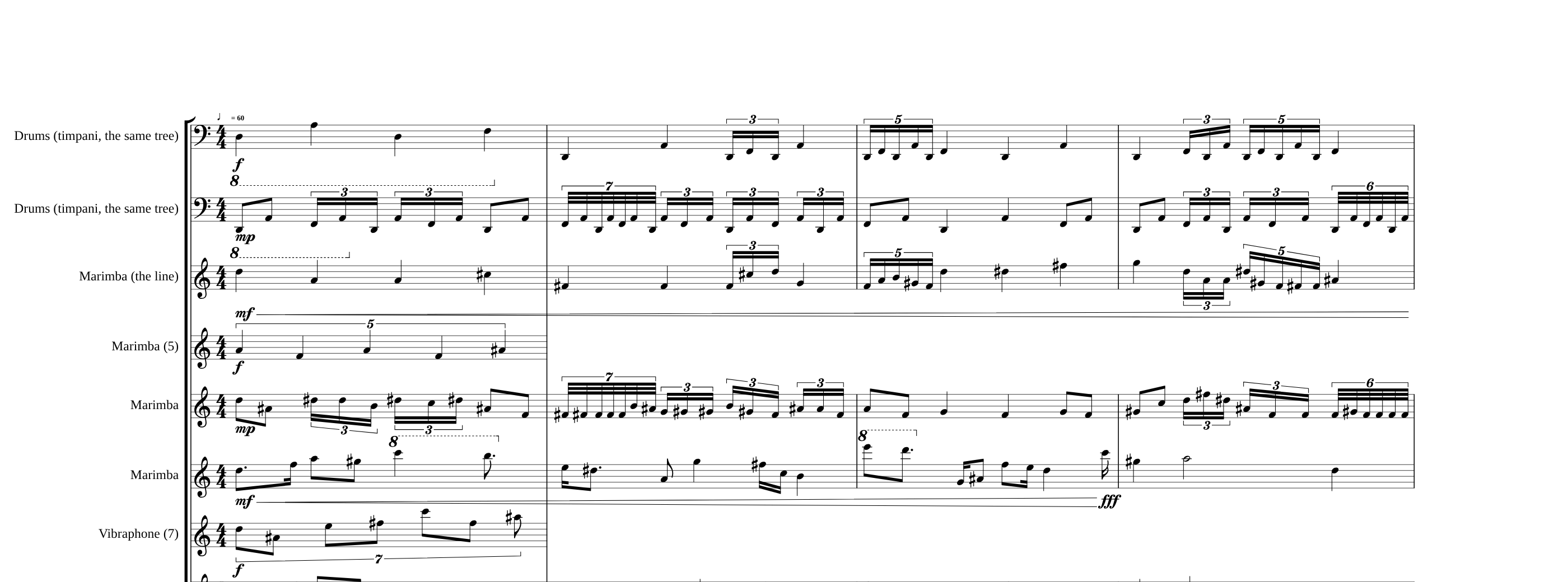
Zappa
The Black Page — statistical density
The Black Page: nested tuplets bar by bar, five against seven, a density envelope thickening the tuplets across the page, the tune quantised from…
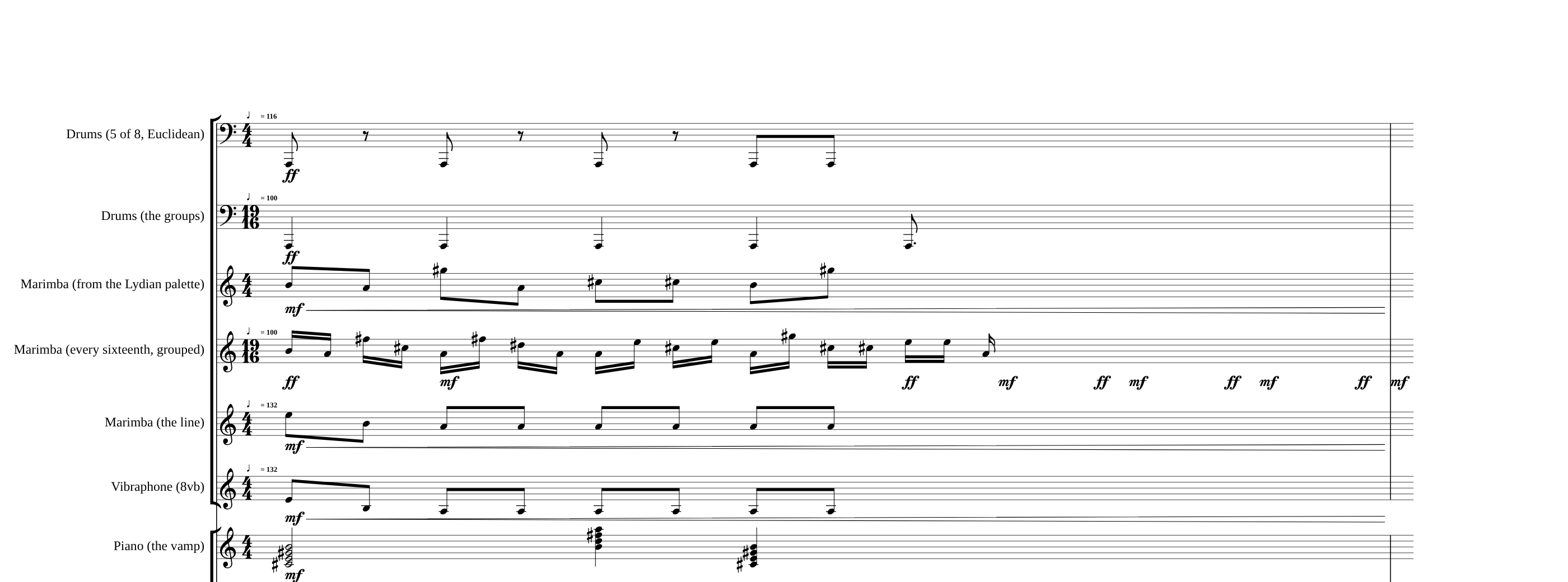
Zappa
Inca Roads — the Lydian vamp, 19/16, and the angular line
Inca Roads: a two-chord Lydian vamp from typed chord symbols with its scale derived, a whole tune in 19/16, and the angular mallet line in shifting…
Zappa
G-Spot Tornado — Synclavier stochastics
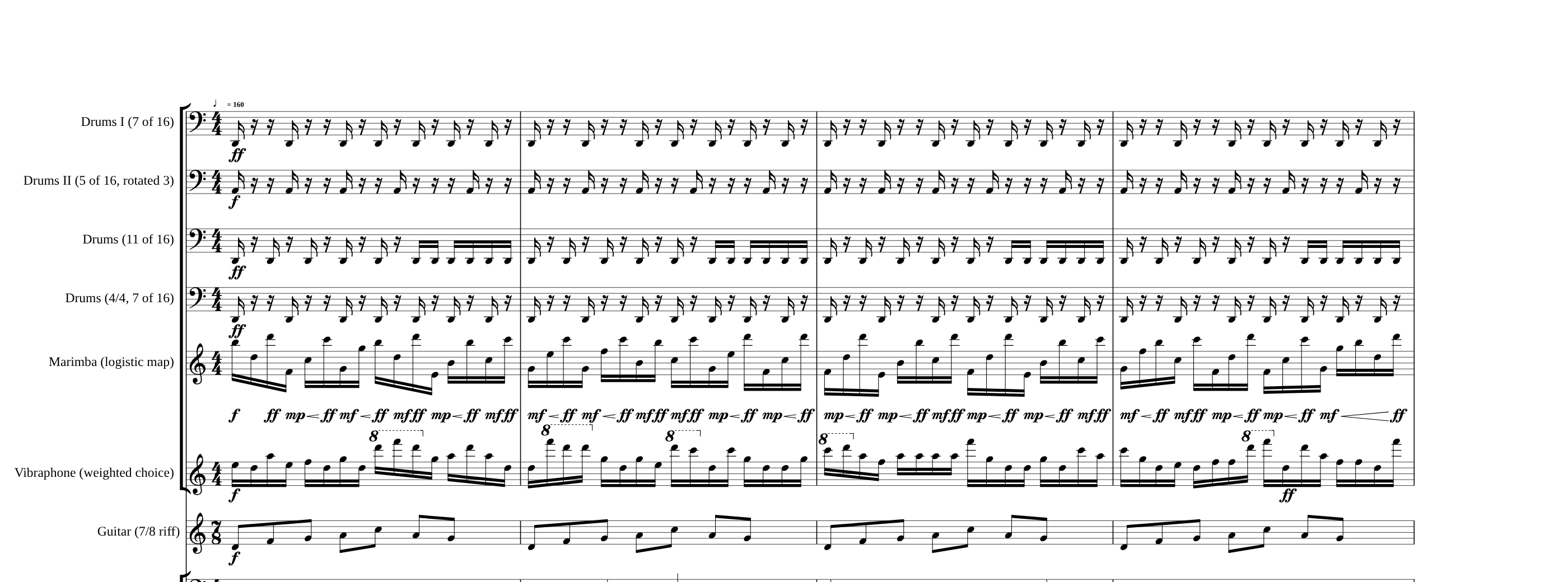
G-Spot Tornado: Euclidean drums, weighted-choice and Markov lines, the logistic map driving pitch and dynamics, and a 7/8 guitar over 4/4 drums.
Ferneyhough
Nested tuplets, parametric polyphony and rows under automatic operations.
Ferneyhough
Bone Alphabet — strata, filters, tempi
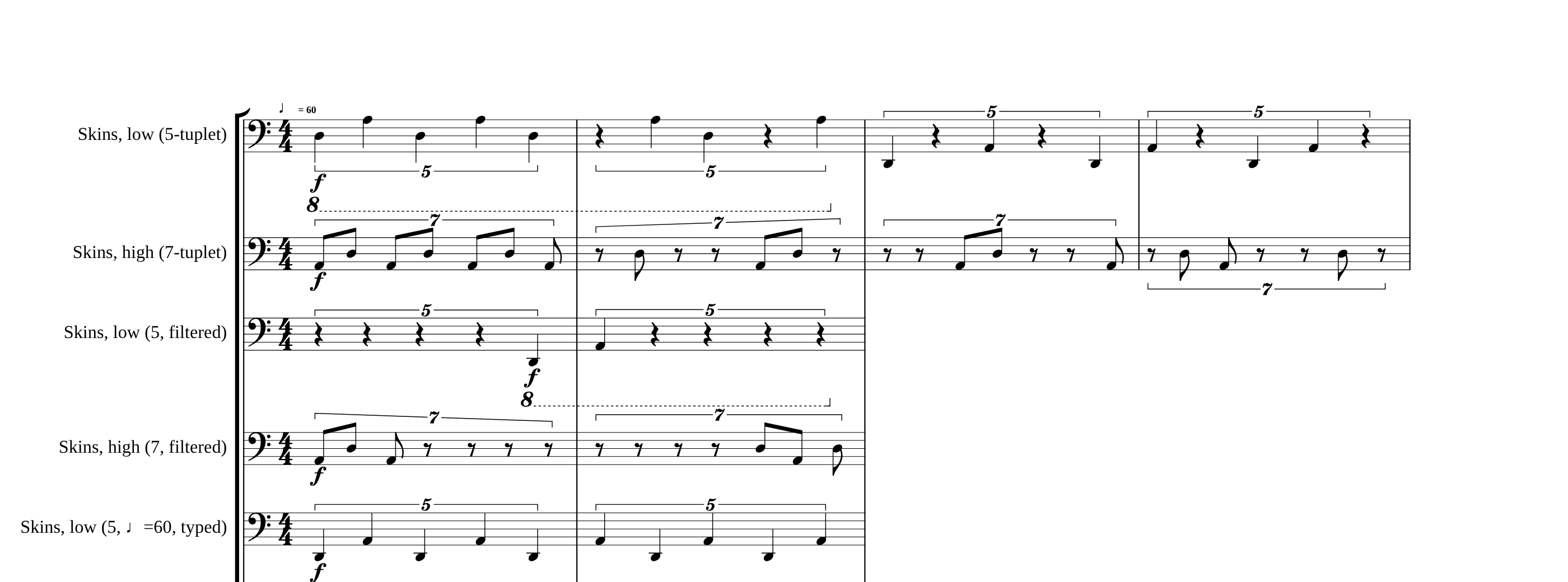
Bone Alphabet: four percussion strata in 5-, 7-, 9- and 11-tuplets, worked over by rest insertion, rotation and retrograde, thinned by density…
Ferneyhough
Unity Capsule — parametric polyphony
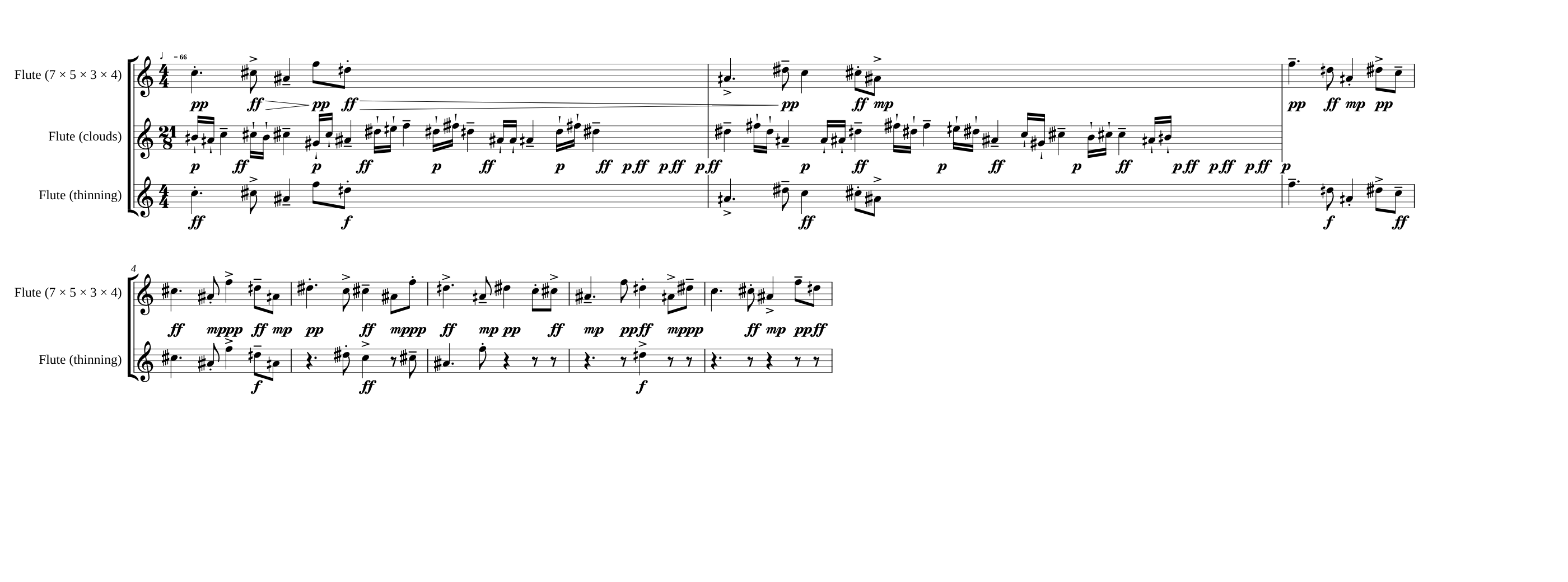
Unity Capsule: parametric polyphony for solo flute in quarter-tones — four parameters cycling at coprime lengths, grace-note clouds that make their…
Ferneyhough
Lemma-Icon-Epigram — a row, a number series, and their transformations
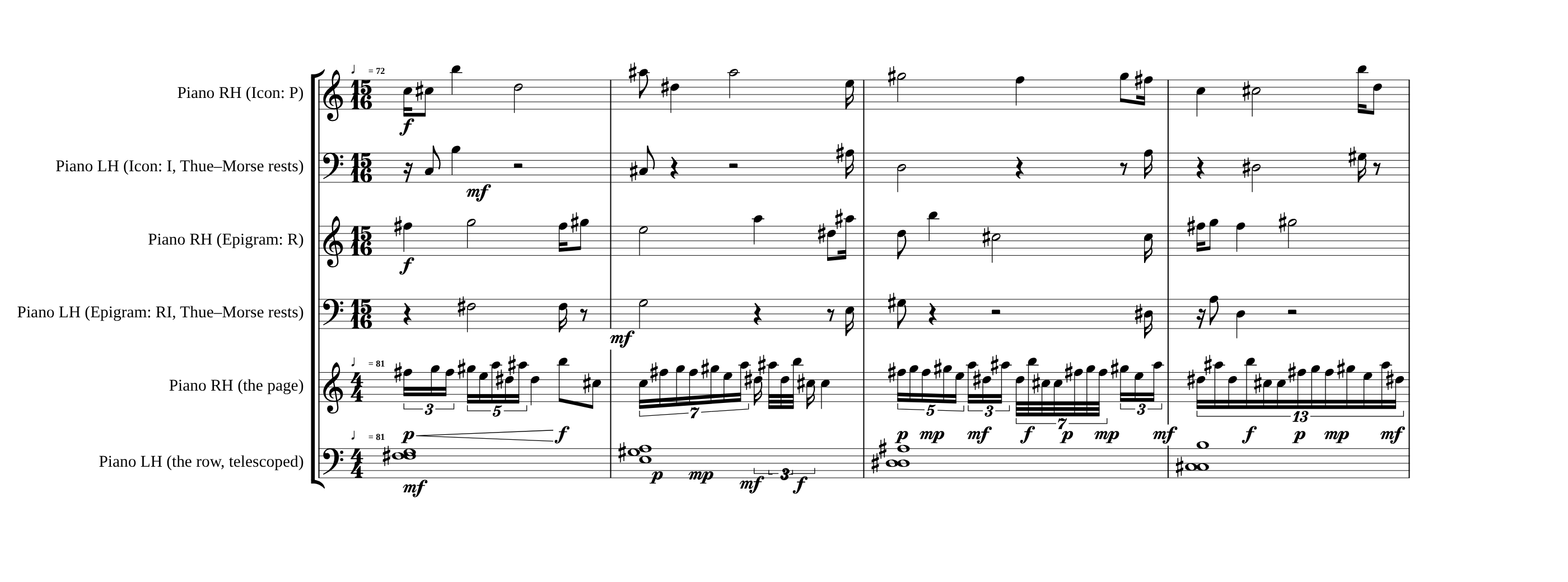
Lemma-Icon-Epigram: a row and a number series under automatic operations — powers of two as durations, Thue–Morse as rests, rotation, retrograde…
Grieg
A phrase rising through four cells, the Hardanger fiddle, bells and a motif.
Grieg
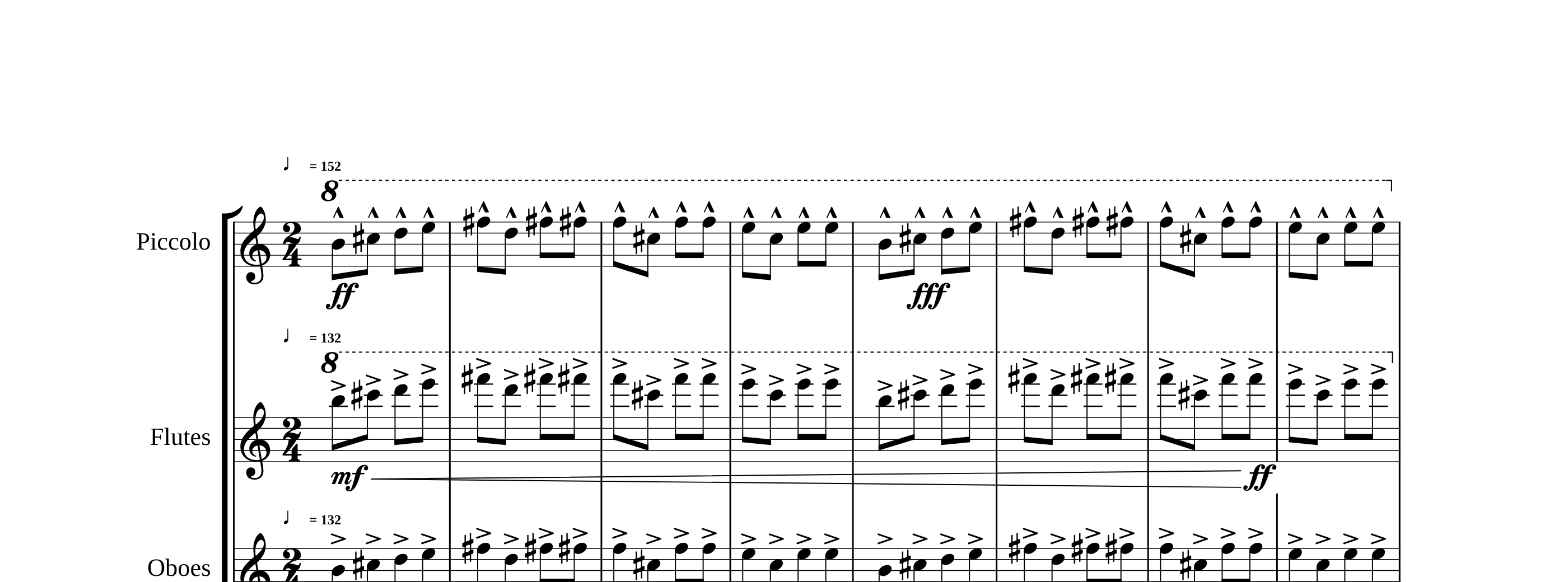
In the Hall of the Mountain King — one phrase, rising, faster, louder
In the Hall of the Mountain King: one phrase, unchanged in four cells, while register, instruments, tempo, dynamics and articulation climb around it.
Grieg
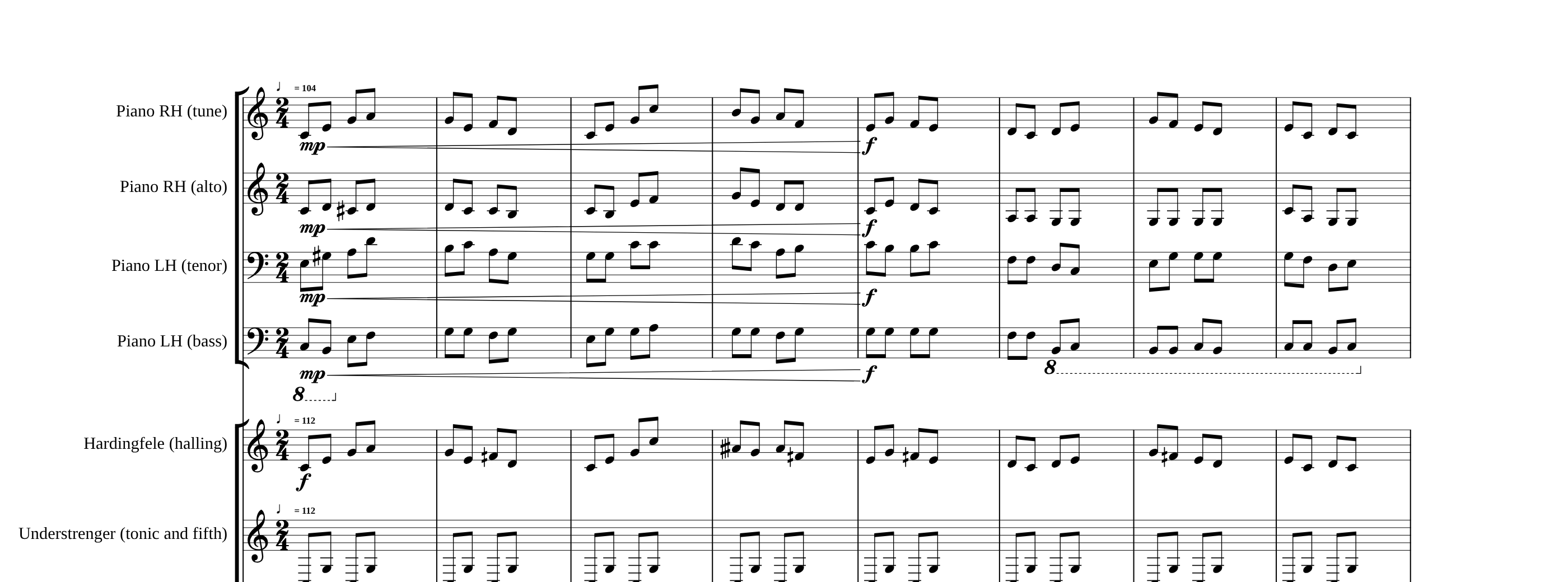
Slåtter — the Hardanger fiddle: drone, high fourth, springar
Slåtter: a halling with the Hardanger fiddle's quarter-tone-high fourth over drones, a springar from the Polska node, and the same tune harmonized…
Grieg
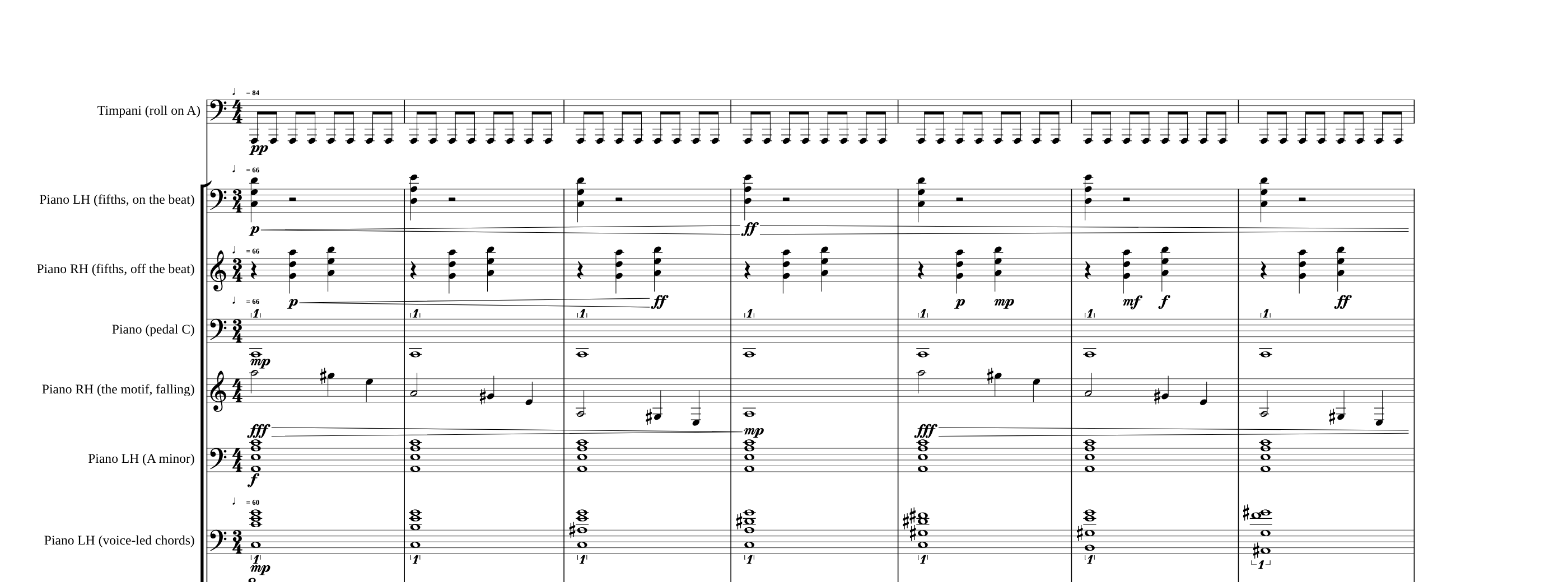
Lyric Pieces — bells, the Grieg motif, a chromatic inner voice
Lyric Pieces: Bell Ringing's stacked open fifths, the Grieg motif falling through the octaves, and a chromatic inner voice from Voice Lead under the…
Bartók
Fifths and the golden section, Bulgarian rhythm, polymodality, night music.
Bartók
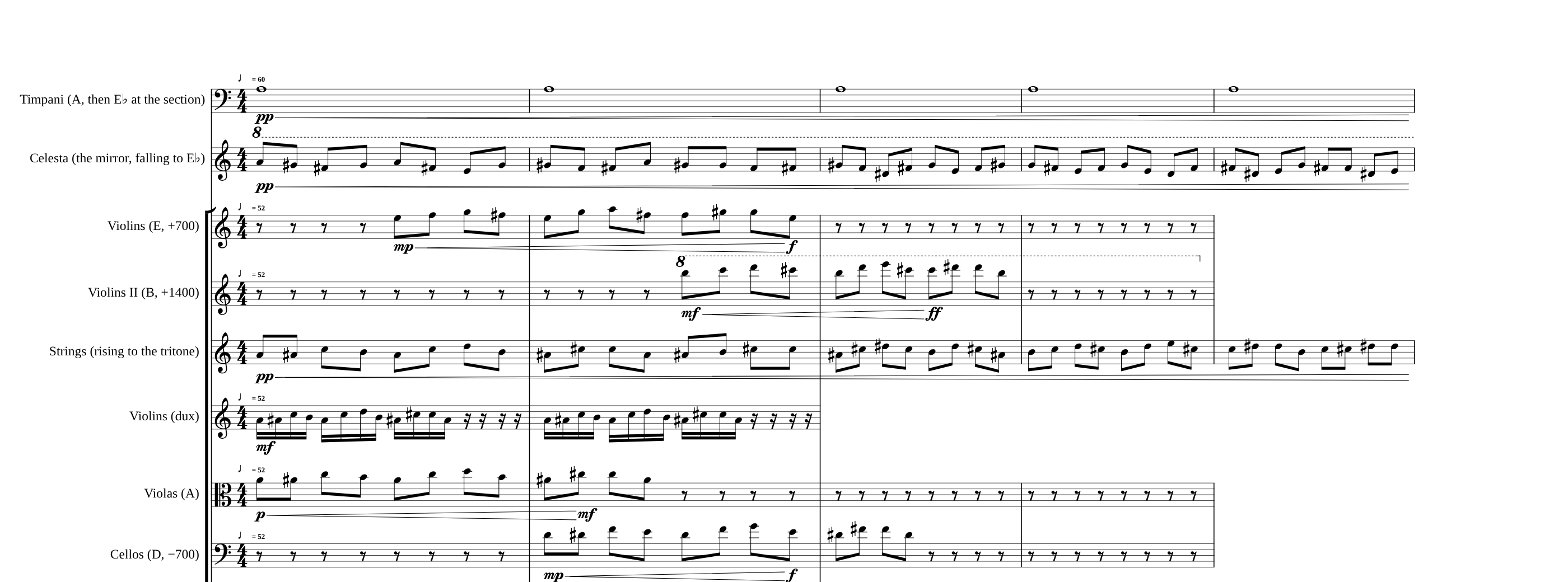
Music for Strings, Percussion and Celesta — fifths, the golden section, the mirror
Music for Strings, Percussion and Celesta: fugue entries spiralling by fifths both ways, a climax at the golden section on the tritone, the subject…
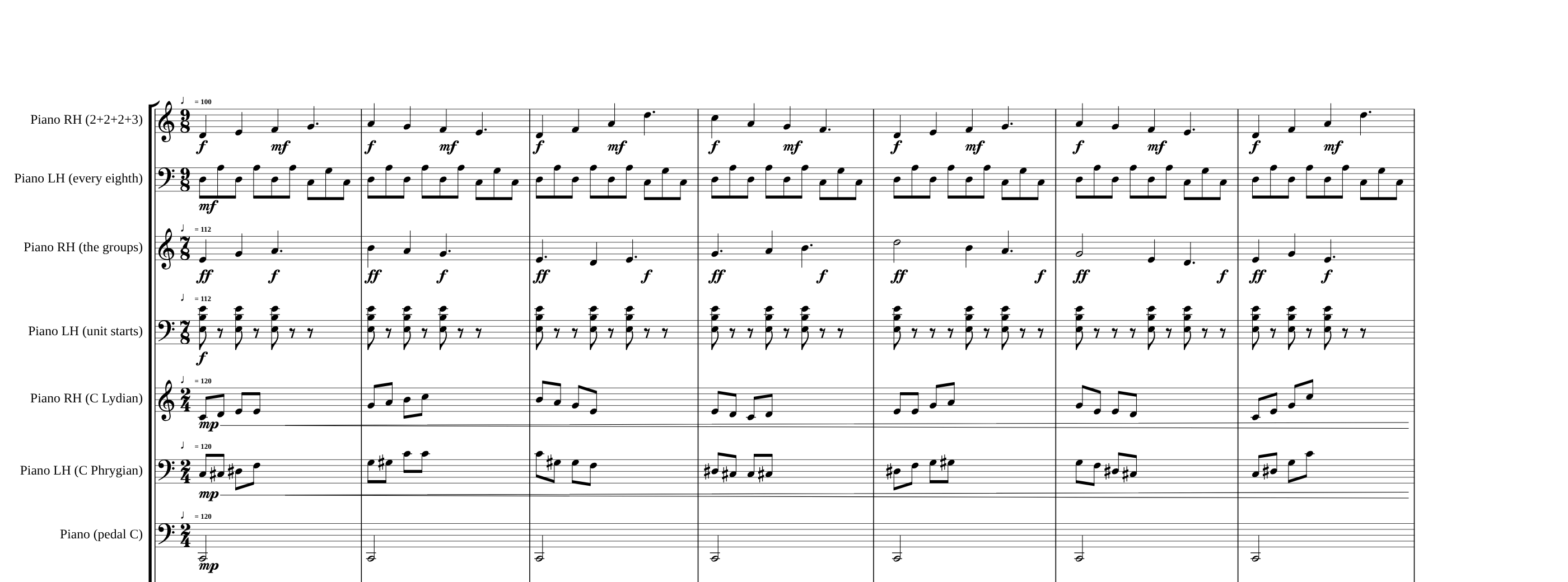
Bartók
Mikrokosmos — Bulgarian rhythm, polymodal chromaticism, the axis
Mikrokosmos: Bulgarian rhythm from the Aksak usûl and changing groupings, Lydian over Phrygian on one tonic, and the axis system walked through…
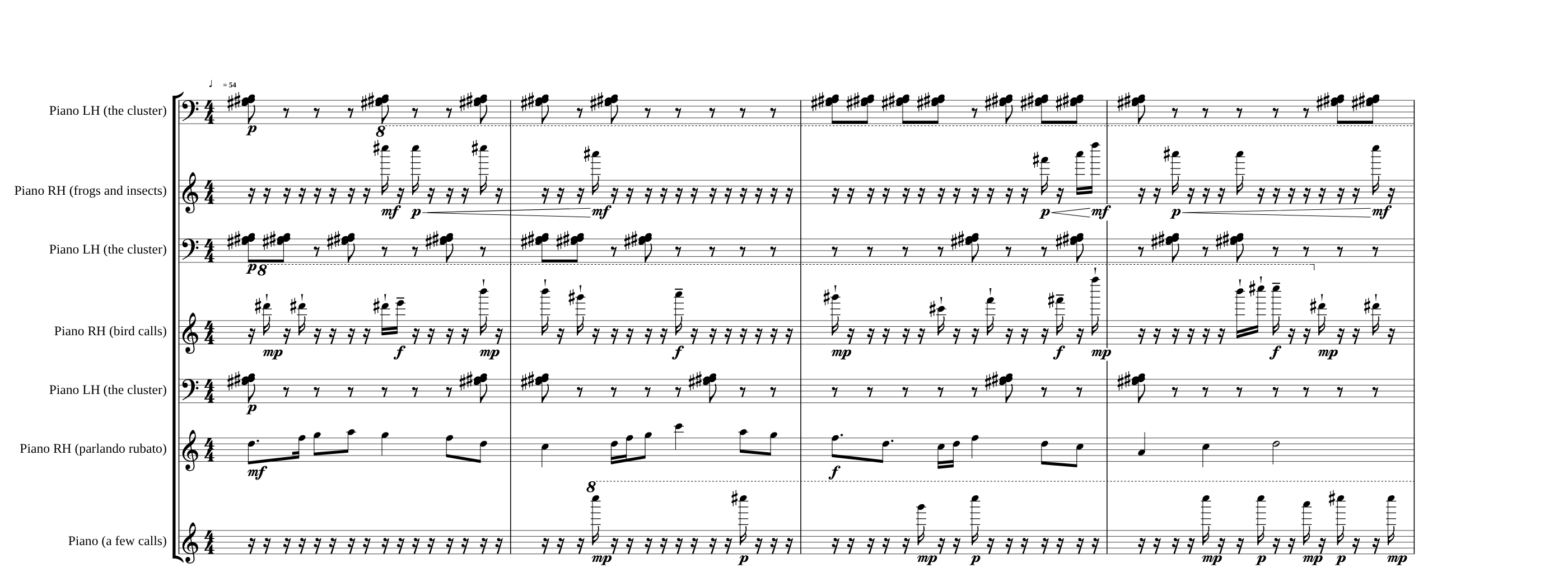
Bartók
Out of Doors — The Night's Music
The Night's Music: a cluster thinned by seeded chance, frogs and insects on a sparse grid, bird calls as grace-note clouds, a pentatonic tune…
Ligeti
Micropolyphony, the études' two hands, clocks and clouds.
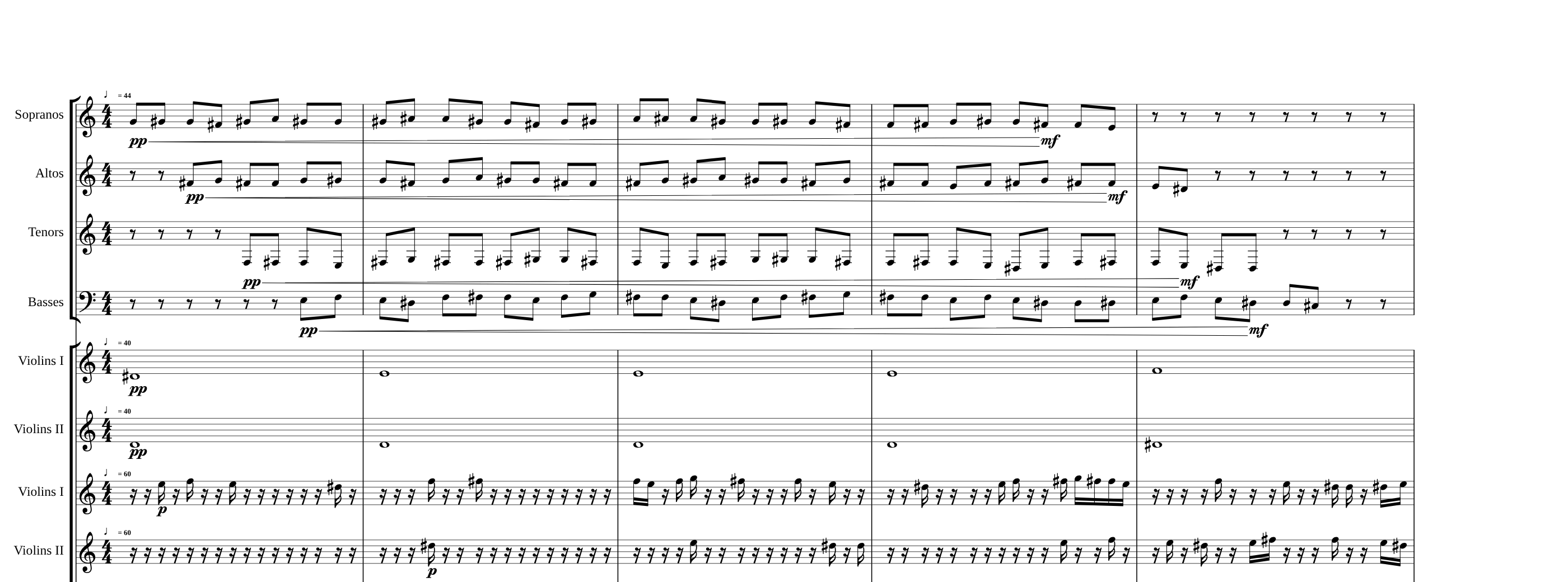
Ligeti
Atmosphères, Lux Aeterna — the cluster, the canon, the cloud
Micropolyphony: a cluster that migrates one voice at a time, a canon at the semitone with entries two eighths apart, and the same line thickening…
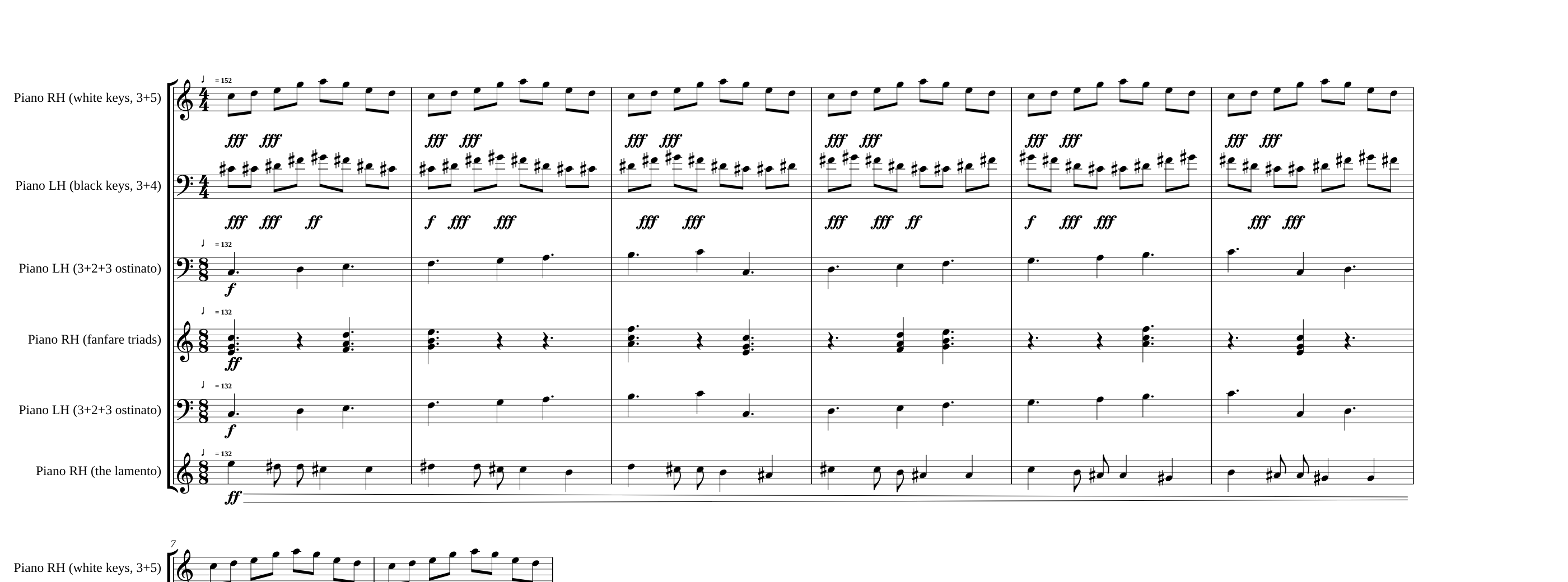
Ligeti
Études — Désordre, Fanfares, the lamento
Études: Désordre's white keys against black keys at eight and seven, Fanfares' 3+2+3 ostinato with its triads, and the lamento falling a semitone…
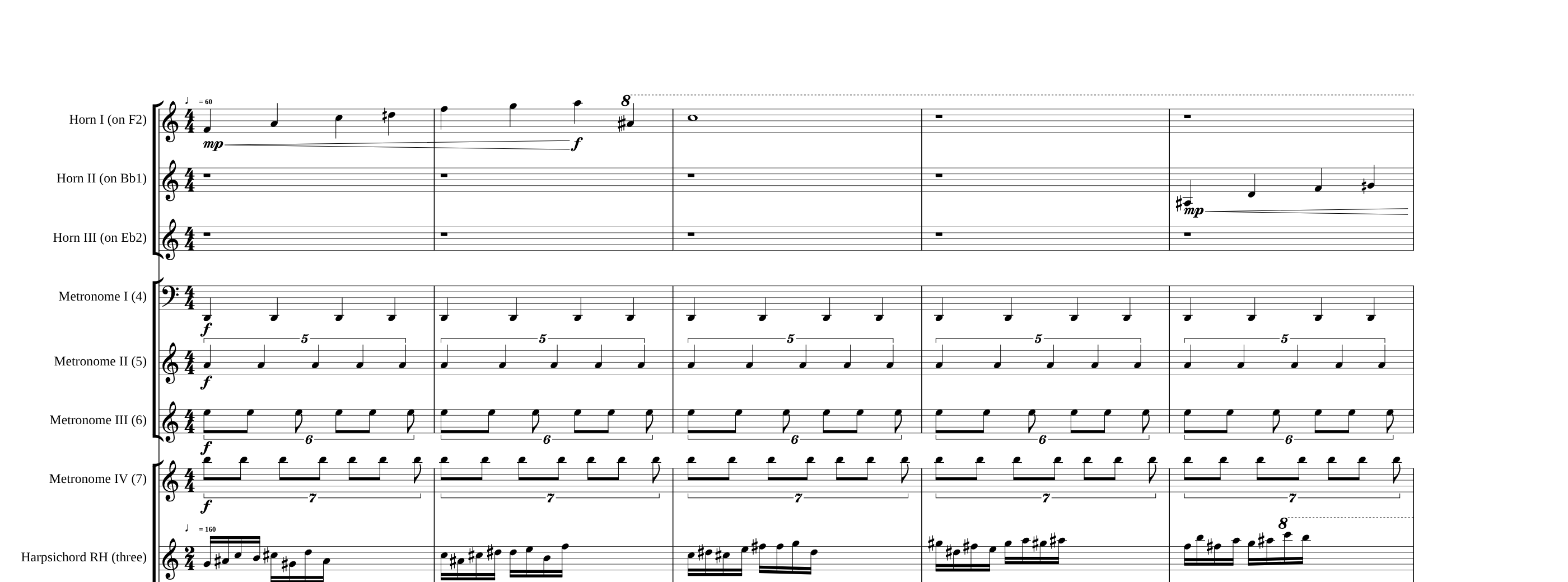
Ligeti
Clocks and Clouds — metronomes, Continuum, the natural horn
Clocks and Clouds: four metronomes dividing one bar into 4, 5, 6 and 7, Continuum's three-against-two creeping upward, and natural horns on the…
Messiaen
Rhythmic pedals, non-retrogradable rhythms, the mode of values and birdsong.
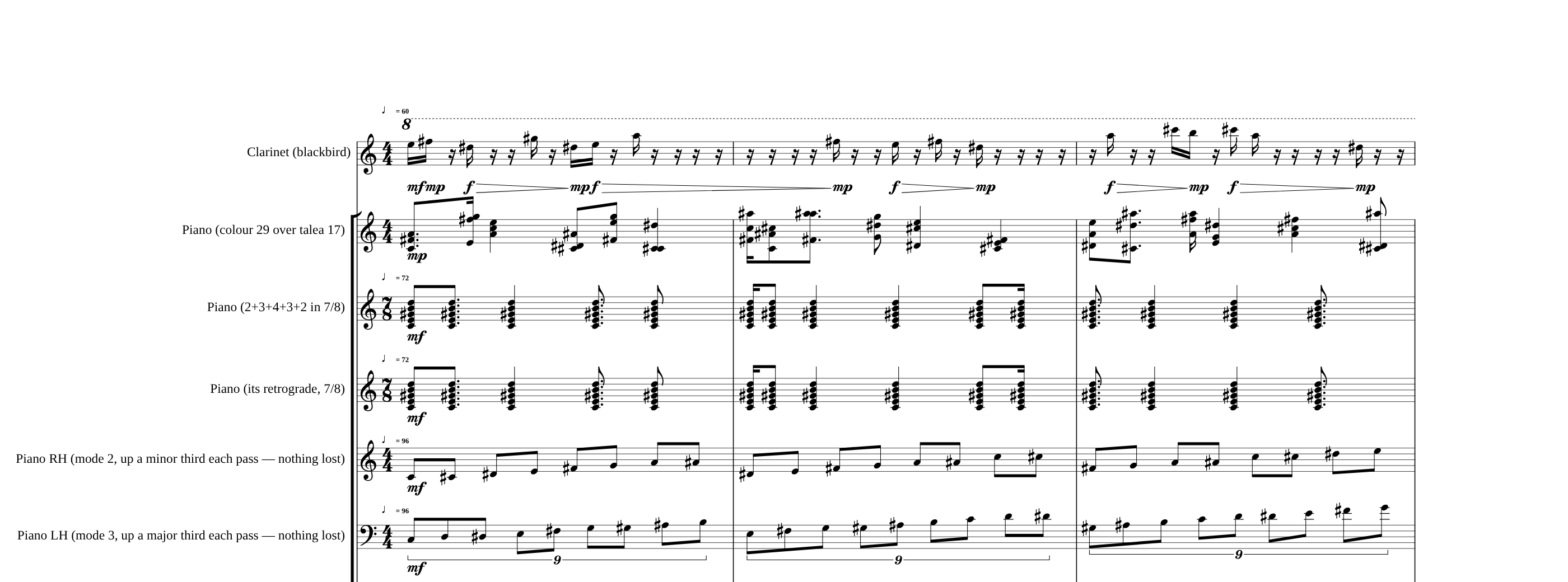
Messiaen
Quatuor pour la fin du Temps — the rhythmic pedal, the palindrome, the modes
Quatuor pour la fin du Temps: 29 chords against 17 durations, non-retrogradable rhythms proved identical to their retrogrades, the modes of limited…
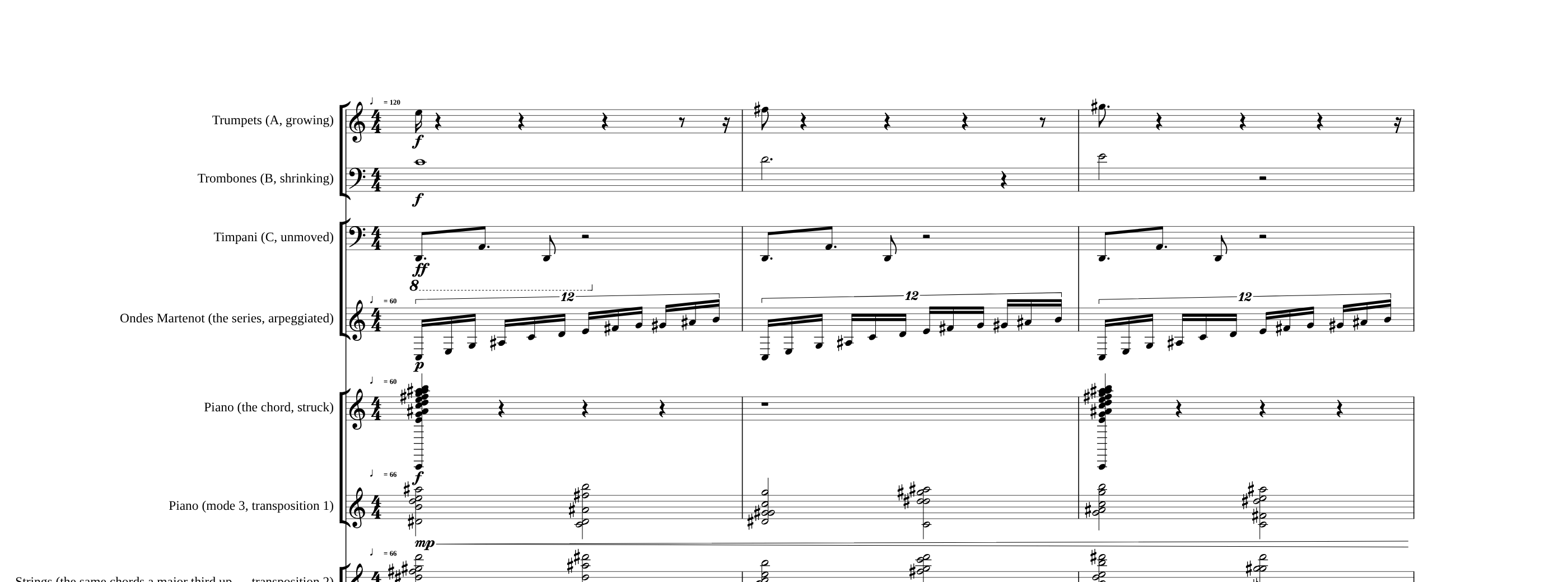
Messiaen
Turangalîla — rhythmic characters, the chord of resonance, colour
Turangalîla: rhythmic characters that grow, shrink and stay, the chord of resonance from the harmonic series, and mode 3 colour chords in two…
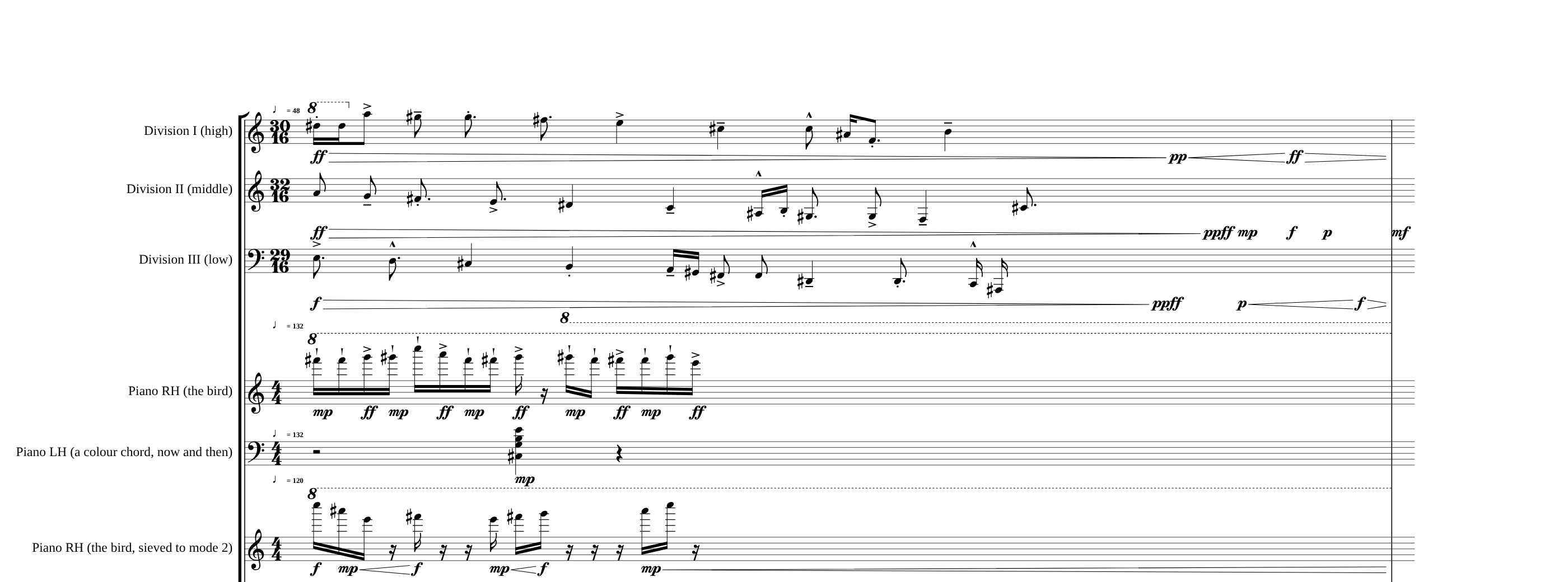
Messiaen
Mode de valeurs et d'intensités, Catalogue d'oiseaux — the mode of values, the bird
Mode de valeurs and the Catalogue: every pitch bound to its own duration, dynamic and attack; a Markov bird with grace-note clouds; the bird sieved…
Bach
The C major prelude, bar for bar, as three pitches a bar through a pattern.
Satie
Gymnopédie No. 1 complete, one moment per phrase.
Beethoven
The Fifth's opening, the Moonlight Sonata's first page and the Seventh's Allegretto from the parts.
Beethoven
Beethoven — Symphony No. 5, opening
The first 58 bars of Beethoven's Fifth for strings and clarinets: the motto from four pitches, imitation, tutti, the crescendo's sequence from…
Beethoven
Beethoven — Moonlight Sonata, opening
The Moonlight Sonata's Adagio sostenuto, bars 1–31, as three staves: melody, triplets arpeggiated from their triads by Pattern Apply, and bass…
Beethoven
Beethoven — Symphony No. 7, Allegretto
Beethoven's Seventh, Allegretto, bars 1–74 for orchestra: each strain stated once and sent on the score bus, the restatements received and…
Saariaho
Spectra that morph, formant filtering, the tone-to-noise axis and the Lichtbogen rhythm engine.
Serial technique
Row forms, transposition, interval expansion and a canon on a twelve-tone row.
Buses between cells
One cell sends a pitch sequence and a rhythm to the whole score; other cells receive and vary them.
Take one apart. Then write your own.
Create a free account14 days of Composer Pro, no card needed. Every account opens with the Examples folder.